In This Article
- When the Pain Scale Falls Short
- When Your Pain Isn’t Believed
- The Pain of Getting Your Pain Measured
- Finding a Language for Pain
- When Ten Isn’t Enough
- A Five Isn’t Always Just a Five
- Finding the Words Before You Need Them
- What Does Pain Mean for Your Life Today?
- Looking Beyond the Number
When the Pain Scale Falls Short
“On a scale of zero to ten, how much pain are you in?”
It’s probably one of the most familiar questions in medicine. And one of the most frustrating questions for someone living with Complex Regional Pain Syndrome (CRPS).
For the first few years, whenever a doctor asked me to rate the pain, my answer was always the same.
“100.”
I wasn’t trying to be difficult. I simply couldn’t find a number on that little scale that came close to describing what I was experiencing.
How do you explain pain that feels like your bones are burning? Or a limb that’s freezing cold and painfully burning at the same time? Pain that shoots, stabs, crushes, and throbs, sometimes all at once?
And that’s before we even begin talking about allodynia, where something as harmless as a bedsheet, a passing breeze, or the lightest touch can become excruciating.
Most people, including many healthcare professionals, have never personally experienced prolonged neuropathic pain. They may understand it medically, but knowing what nerve pain is and living with it every hour of every day are two very different things.
CRPS adds still more layers: swelling, changes in temperature and color, muscle stiffness, and extreme sensitivity to the environment.
Yet somehow, we’re expected to squeeze all of that into a number between zero and ten.
The problem isn’t that pain scales are useless. It’s that one number can’t tell the whole story.
When Your Pain Isn’t Believed
One of the most painful experiences for someone living with CRPS isn’t always physical.
It’s not being believed.
Many people with CRPS report having their symptoms questioned, their pain dismissed as exaggerated, or their condition attributed primarily to psychological problems.
Some find themselves directed toward psychiatric treatment when what they desperately need is recognition, proper assessment, and appropriate treatment of their physical condition.
Let’s be clear: CRPS pain is real.
CRPS is a recognized chronic pain condition involving changes in the nervous system and other physiological processes. Its symptoms can be severe, unpredictable, and extraordinarily difficult to communicate.
A patient who cries, becomes agitated, or struggles to remain calm during an examination isn’t necessarily displaying a psychiatric problem. They may be experiencing overwhelming pain.
Psychological support can be valuable when living with chronic pain. But it should complement appropriate medical care, not replace it.
Distress is not evidence that pain is exaggerated.
And sometimes, even the smallest misunderstanding can have lasting consequences.
The Sunglasses Story

For the first five years, I wore sunglasses to appointments with my pain doctor.
Not as a fashion statement. Not because I was trying to hide behind them.
I wore them because I was extremely sensitive to light, and the bright lights in medical offices were painful.
Years later, I discovered that my doctor had interpreted my sunglasses as rude.
He had never asked why I was wearing them.
It’s a small example of a much larger problem.
What looks unusual, unfriendly, or uncooperative from the outside may be someone doing their best to manage an invisible symptom.
Sunglasses indoors. Avoiding a handshake. Standing instead of sitting. Keeping a distance from other people. Asking for the lights to be dimmed.
These aren’t necessarily preferences or personality traits. Sometimes they’re the adjustments that make it possible for someone with CRPS to be there at all.
Before judging a patient’s behavior, ask what they’re experiencing.
The Pain of Getting Your Pain Measured
Here’s something that rarely makes it into a pain score.
By the time someone with CRPS reaches a doctor’s office, the pain may already be considerably worse than it was when they woke up.
First, there’s getting dressed. Clothes touching sensitive skin, shoes pressing against painful feet, perhaps struggling to move a stiff limb.
Then comes leaving the house.
The vibration of a car, every bump in the road, unexpected noises, changes in temperature, and the stress of traveling when you’re already in pain.
Finally, you arrive at the clinic.
There’s the waiting room, the uncomfortable chairs, people moving around you, and perhaps an air conditioner blasting cold air directly onto a painful limb.
And then the doctor asks:
“On a scale of zero to ten, how much pain are you in?”
Well, that depends.
Do you mean before I got dressed, before the car ride, or after sitting in your waiting room?
It’s not that the question is unreasonable. It’s that the answer needs context.
The journey to have your pain measured may have changed the very thing you’re trying to measure.
Finally, a Language for Pain:
The McGill Pain Questionnaire
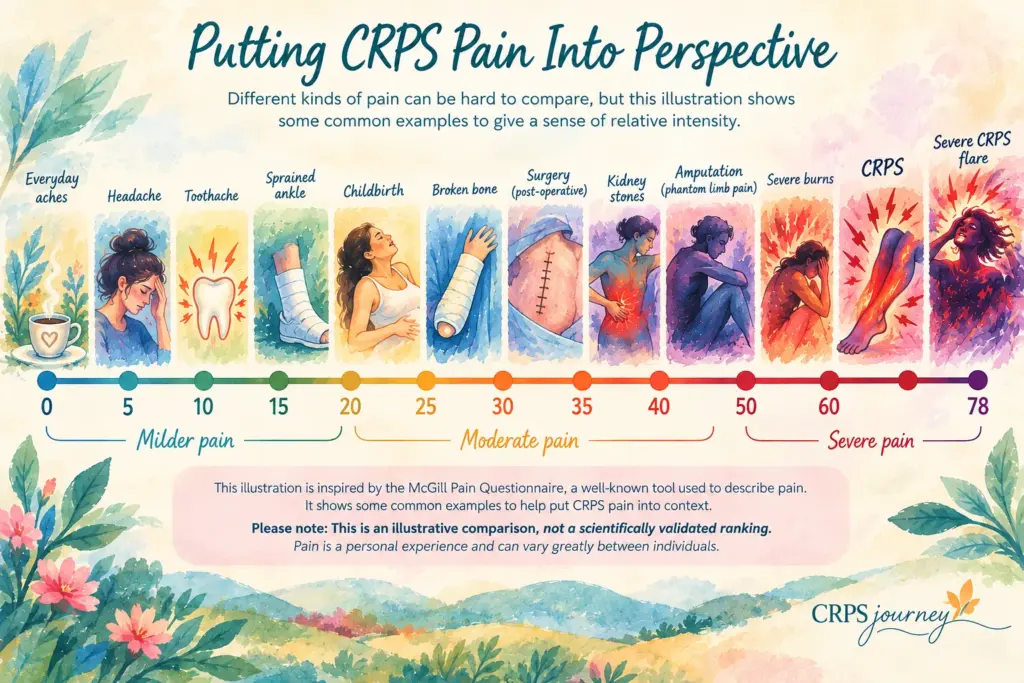
One of the limitations of the familiar zero-to-ten scale is that it measures pain intensity without telling us much about what the pain actually feels like.
Is it burning? Freezing? Stabbing? Crushing? Does it feel like an electric current running through your body?
Sometimes the answer is several of these at once.
The McGill Pain Questionnaire, developed by researchers at McGill University, offers something the numerical scale cannot: a vocabulary for pain.
Instead of relying on a single number, it asks patients to choose words that describe their experience.
Its descriptors cover different dimensions of pain, including:
- Sensory qualities: such as shooting, stabbing, burning, and throbbing.
- Emotional and experiential qualities: such as exhausting, frightening, and punishing.
The questionnaire recognizes that pain has multiple dimensions, including its physical sensations and emotional impact.
For someone with CRPS, seeing these words in a recognized clinical questionnaire can be reassuring.
Finally, there are words for some of what you’re experiencing.
The McGill questionnaire was not developed specifically for CRPS, and it doesn’t assign CRPS a universal ranking among painful conditions. But it provides a scientifically established framework for describing pain beyond intensity alone.
It can also be a useful resource to share with healthcare professionals and loved ones who struggle to understand the complexity of CRPS pain.
Sometimes finding the right words is the first step toward being understood.
When Ten Isn’t Enough
It took me years to learn how to place the CRPS pain somewhere on the zero-to-ten scale.
And even then, I discovered something else.
The scale doesn’t stay still.
What I called an eight last year might be a five this year.
Our reference points can change with experience, treatment, and the changing nature of pain itself.
Sometimes we adapt to living with a level of pain that once seemed unimaginable. Sometimes treatment genuinely reduces our symptoms. Often, both things influence how we interpret the numbers.
And ten?
I have my own definition.
“Ten is when I can’t stop screaming”
Not everyone will define ten that way, of course. That’s part of the difficulty.
An eight for one person may mean something entirely different from an eight for someone else. Even within the same person, the meaning of a number can change over time.
Pain scores are subjective by design. They reflect the experience of the person reporting them.
That’s why they’re generally more useful when considered alongside changes in symptoms, function, and daily life.
A Five Isn’t Always Just a Five
There’s another thing I’ve learned over the years.
Knowing how much pain you’re in isn’t always enough.
You also need to recognize where it’s heading.
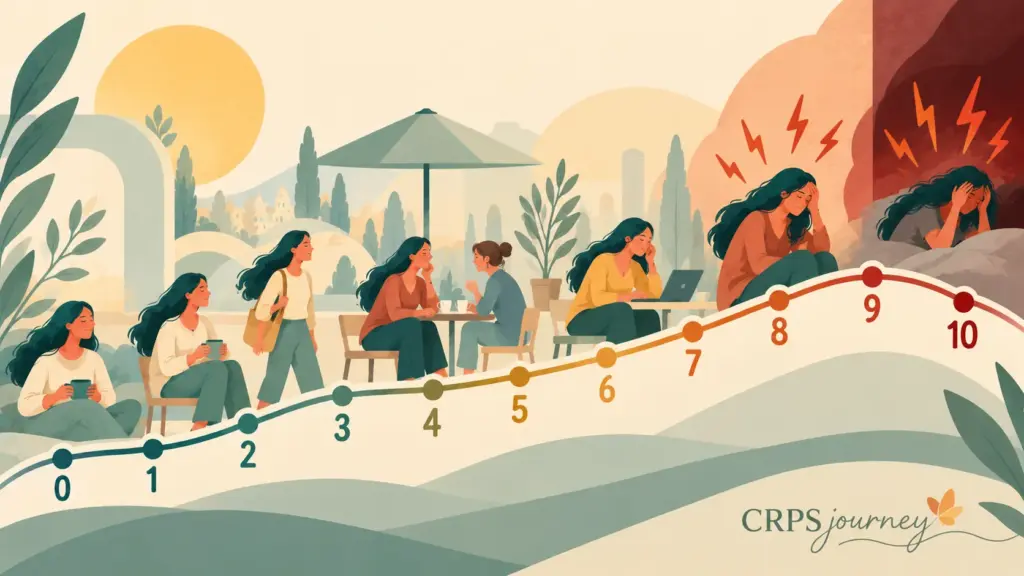
A pain level of five after resting quietly at home may be very different from a five that’s rapidly climbing after an exhausting afternoon.
Medication, rest, activity, temperature, stress, and sensory stimulation can all influence pain levels, sometimes within a short period.
Your pain level tells you where you are. Your pain trend tells you where you might be heading.
Over time, I learned to recognize the early signs that the CRPS pain was escalating.
And I learned something important: once a flare has gathered momentum, it can be much harder to settle.
That doesn’t mean every flare can be prevented. CRPS doesn’t always give us warning, and even when it does, our efforts won’t always work.
But recognizing those early signals can create an opportunity to respond.
Catch the Climb
Sometimes the most useful thing you can do is stop.
Stop the activity. Reduce the noise. Find a comfortable temperature. Move somewhere quieter, with softer lighting and fewer demands on your senses.
Slow, gentle breathing can help encourage the body’s relaxation response, easing some of the tension and heightened arousal that accompany pain.
It won’t switch off CRPS, but it may help reduce the additional stress on an already overwhelmed nervous system.
If your doctor has prescribed SOS (rescue) medication for breakthrough pain, keep it accessible and follow your agreed treatment plan.
And remember that comfort can take many forms.
For some people, a warm shower with water gently running over the neck or back can be soothing. For others, it might be a quiet room, a familiar voice, or cuddling with a beloved pet.
Our bodies have natural pain-modulating and stress-regulating systems, involving chemicals such as endorphins and oxytocin. Relaxation, comforting experiences, and social connection may help influence how we experience pain and stress, although their effects vary and aren’t specific treatments for CRPS.
Of course, with allodynia, even warmth or a hug can hurt.
Your comfort toolkit should be built around what actually feels comfortable to you.
And sometimes, the most important tool is simply knowing when to ask for help.
When Asking for Help Becomes Another Challenge
Just this week, I found myself in an emergency room, trying to explain to the staff that the CRPS pain was escalating and getting out of control.
I knew the warning signs. I knew what was coming. And I needed someone to listen before things became worse.
Eventually, I had to get out of the hospital bed and limp to the nurses’ station in the next room.
They told me to go back to bed.
I had to raise my voice.
“The fact that I’m standing on two feet with CRPS doesn’t mean I can walk back. I’m human, and I need help.”
Being able to stand doesn’t mean standing is easy. Being able to walk a few steps doesn’t mean you can walk a few more.
And managing to push through severe pain to ask for help doesn’t mean the pain isn’t severe.
Sometimes what looks like an ability is actually an act of desperation.
What a patient manages to do in a moment of necessity isn’t necessarily a measure of what they can safely or comfortably do.
That’s another reason pain assessment needs to go beyond numbers—and why listening to patients when they say their pain is escalating matters.
Finding the Words Before You Need Them
When pain is climbing, explaining what’s happening can become another exhausting task.
I’ve found it helpful to recognize escalation early and communicate it to the people around me.
You might prepare a few simple phrases in advance:
To someone nearby:
“My pain is climbing. I need to stop now, before it gets worse.”
To family or friends:
“I need quiet and a little space. I’ll tell you when I’m ready.”
To a healthcare professional:
“My pain was a four when I left home. It’s now a seven and still increasing.”
To yourself:
“I don’t have to finish this right now.”
These aren’t magic words. But they can make it easier to communicate your needs when you have little energy left for explaining.
And learning to stop before you’re overwhelmed isn’t giving up.
It’s pacing.
What Does Pain Mean for Your Life Today?
Perhaps the most important limitation of a pain scale is what it doesn’t ask.
It tells us how much something hurts, but very little about how we’re actually living.
So perhaps the better question isn’t simply:
“How much pain are you in?”
Perhaps it’s also:
“What does that pain mean for your life today?”
Did you manage to sleep for a few hours without waking from pain?
Could you get out of bed this morning? Get dressed without help?
Have you eaten breakfast? Or has the pain made even preparing something to eat feel impossible?
Could you take a shower, walk to the kitchen, sit comfortably for a little while, or enjoy a conversation without being overwhelmed?
These may sound like ordinary things.
For someone living with CRPS, they can be enormous achievements.
And there’s another question worth asking:
How long did it take you to recover afterward?
Being able to do something is only part of the story. What it costs you afterward matters, too.
Sometimes progress doesn’t mean doing more. It means doing the same thing with less pain, less exhaustion, or a shorter recovery.
Sometimes it’s sleeping better, tolerating clothing, spending more time with people you love, or discovering that a small pleasure has become possible again.
These changes may not produce dramatic improvements on a numerical pain scale.
But they can make an enormous difference to quality of life.
Looking Beyond the Number
None of this means we should abandon pain scales.
They can help us communicate changes, evaluate treatments, and recognize when symptoms are getting worse.
The McGill Pain Questionnaire and other established assessment tools can also help healthcare professionals understand aspects of pain that a simple number misses.
But a pain score should be the beginning of a conversation, not the end of one.
Instead of reporting only a number, we can try adding a little context:
“My pain is a five today. But I slept through the night, managed a shower, and walked to the kitchen without assistance. Last month, I couldn’t do any of those things.”
Or:
“My pain is only a four right now, but it’s rising quickly, and I’m becoming increasingly sensitive to noise and touch.”
Both statements communicate something important that a number alone cannot.
Living with CRPS means learning a new language for our bodies. It takes time to recognize patterns, communicate needs, and discover what helps us live a little better.
And while reducing pain remains an important goal, it isn’t the only measure of progress.
A pain score tells us how much we hurt. It doesn’t tell us how much of our lives we can live.
So alongside the familiar question, “How much does it hurt?”, perhaps we should start asking another:
“What would you like to be able to do more of?”
Because you are more than CRPS.
And your life is more than a number.