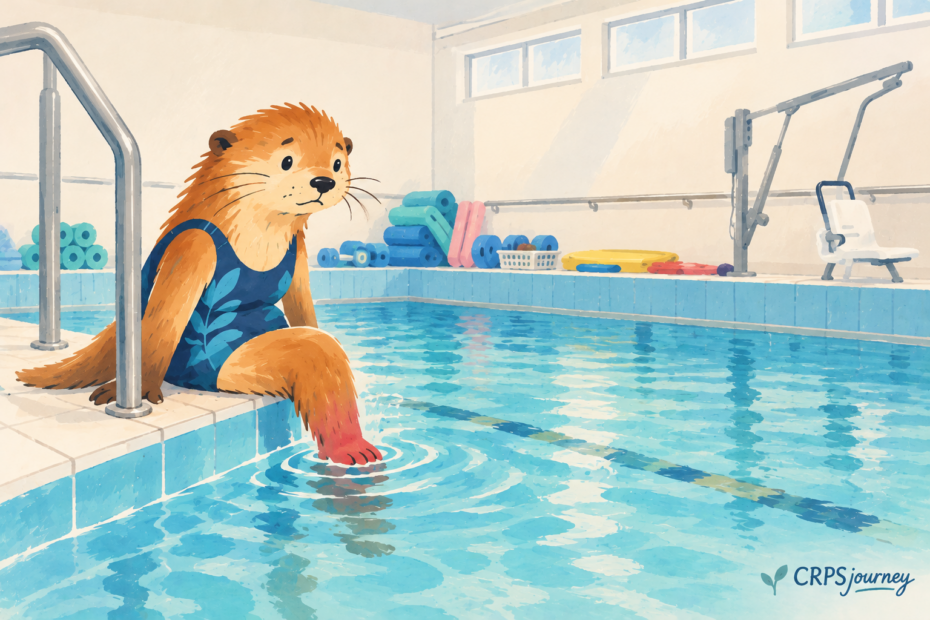
Water can be wonderfully relaxing. A warm bath, a refreshing swim or simply floating without having to support your own body weight.
For some people living with Complex Regional Pain Syndrome (CRPS), being in water offers a welcome sense of freedom. For others, the sensation of water against their skin can be uncomfortable or painful.
And some people just don’t like swimming. CRPS or no CRPS.
There’s no single relationship with water, just as there’s no single experience of CRPS.
Hydrotherapy offers an opportunity to explore movement in a different environment, but finding what works for you may require a little creativity, patience and the occasional unconventional swimming technique.
Fortunately, we’re not training for the Olympics.
What Can Hydrotherapy Offer?
Hydrotherapy, also called aquatic therapy, uses water to support movement, exercise and rehabilitation.
One of its greatest advantages is buoyancy. Water supports part of your body weight, reducing the load on your legs and joints. Movements that are difficult on land may become easier in the pool.
Warm water can help relax muscles, ease stiffness and make movement more comfortable, particularly for people living with CRPS who are sensitive to cold.
The gentle pressure of water, known as hydrostatic pressure, may also help reduce swelling and support venous circulation. However, that same pressure can be uncomfortable for someone with mechanical allodynia.
For some people living with CRPS, hydrotherapy may be the only form of exercise they can comfortably manage.
And there’s another benefit that doesn’t always appear on a physiotherapy assessment form: the simple pleasure of moving.
Being able to lift a leg, take a few steps or stretch more freely can feel surprisingly liberating when those movements are difficult on land.
Sometimes the greatest benefit isn’t completing an exercise. It’s rediscovering the pleasure of moving your body.
When Water Hurts: Understanding Sensory Sensitivity
Of course, not everyone finds water comfortable.
One reason is allodynia, a symptom in which sensations that wouldn’t normally be painful cause pain.
Water can produce several sensations at once:
- Pressure: Even still water exerts pressure against the body.
- Movement: Ripples, splashes and currents create changing sensations against the skin.
- Temperature: Water that feels comfortable to someone else may feel painfully hot or cold.
- Sound and vibration: Busy indoor pools can be noisy, with echoing voices, splashing and equipment sounds.
For someone with significant sensory sensitivity, these sensations can become overwhelming.
The good news is that tolerance varies considerably. Some people experience little difficulty with water, while others need a carefully adapted approach.
If water contact is painful, it doesn’t mean you’ve failed at hydrotherapy. It simply means your nervous system has a few additional requirements.
And sometimes, quite a long list.
Your Relationship with Water Can Change
CRPS symptoms aren’t necessarily constant.
Your ability to tolerate water may change with time, treatment, medication, activity levels or fluctuations in your symptoms.
Someone who previously struggled with showering may eventually enjoy being in a heated pool. Another person may find that water becomes less comfortable during a flare.
People who benefit from treatments such as spinal cord stimulation (SCS) may also experience changes in pain and sensory tolerance. Anyone with an implanted device should confirm that aquatic activity is appropriate for their particular device and medical circumstances.
Not today doesn’t mean never.
There’s no deadline for getting into the pool, and no reason to turn hydrotherapy into a test of determination.
The goal is to find an activity that works for you, when it works for you.
Preparing for Hydrotherapy
A little preparation can make the experience more comfortable and enjoyable.
And when you’re living with CRPS, preparation sometimes involves considerably more than remembering your swimsuit.
Finding the Right Pool
Hospital hydrotherapy pools are designed for therapeutic exercise and are often heated to around 33°C (91°F), although temperatures vary by facility.
For people who are sensitive to cold, a warm pool can make an enormous difference.
Before booking, ask about the water temperature, pool accessibility, available assistance and changing-room facilities.
It’s also worth checking the schedule.
A quiet pool can be a very different experience from one filled with enthusiastic swimmers, splashing children and someone apparently training for the next Olympic Games.
If you’re sensitive to noise, vibration or water movement, quieter sessions may be preferable.
You Don’t Have to Know How to Swim
You don’t need to be a swimmer to participate in many supervised hydrotherapy programs.
In hospital rehabilitation settings, a physiotherapist may be in the water with you, providing physical assistance, guidance and reassurance.
If you’re nervous about water, tell your physiotherapist before your first session.
You might begin by standing near the steps, holding a handrail or becoming comfortable with the water before attempting any exercises.
The physiotherapist can help you build confidence and adjust the activities to your abilities.
Feeling safe and supported matters just as much as the exercises themselves.
Supervision arrangements vary, so confirm what assistance will be available.
Getting Comfortable with Water Before Your First Session

If water contact is painful (allodynia), you may find it helpful to become familiar with the sensation before attempting the pool.
One approach I found useful was gently pouring comfortably warm water over a less sensitive area of my affected limb, then gradually moving toward more sensitive areas as tolerated. This wasn’t something I accomplished in one attempt. Sometimes it took several tries, and sometimes I stopped and tried again another day.
Something that helped me was reminding myself:
“The pain is real, but the sensation of water doesn’t necessarily mean my body is being injured.”
That distinction helped me feel less apprehensive without dismissing what I was experiencing. The aim isn’t to force yourself through pain, but to explore whether water can become a more familiar, manageable sensation.
If you have impaired temperature sensation, skin changes, wounds or significant symptom flares, discuss this approach with your treating clinician first.
What to Wear
A comfortable swimsuit is a good starting point.
A one-piece swimsuit may be practical for hospital hydrotherapy, but swim shorts and a rash guard (swim shirt) are another option for both men and women.
Rash guards come with short or long sleeves, providing additional coverage and privacy. They may also help you feel a little warmer when leaving the pool.
If you have clothing-related allodynia, pay attention to fabric, seams and tight-fitting garments.
Comfort takes priority over fashion.
Although I suspect the otter in our illustrations would disagree.
Pool Hygiene and Skin Care
Before your first session, ask the facility about its hygiene requirements.
Some hospitals may recommend particular showering or cleansing routines. Check whether antibacterial soap is required rather than assuming it’s necessary.
It’s also important to check for open cuts, wounds or signs of infection. If you have broken skin or a possible infection, ask the clinical team whether entering the pool is appropriate.
And if your skin is particularly sensitive, discuss suitable cleansing products before using anything new.
Medication and Pain Management
Some people may need an individualized medication plan to make hydrotherapy manageable.
Discuss this with your treating physician, particularly if additional prescribed pain relief is being considered before a session. Medications that cause dizziness, drowsiness or impaired balance can create safety concerns around water.
The aim is to make participation comfortable and safe, not to mask symptoms so you can push beyond your limits.
Getting Into the Pool: The First Challenge

Your first session doesn’t have to involve an ambitious exercise routine.
It might begin with standing on a pool step and allowing the water to reach your ankle.
You may gradually immerse more of your affected limb as you become comfortable with the temperature and sensation.
Or you might enter the pool without difficulty and begin moving straight away.
Both experiences are valid.
The starting point depends on your abilities, confidence and sensory tolerance.
In supervised hospital hydrotherapy, the physiotherapist can help you find an appropriate level of activity and provide assistance when needed.
Some people eventually progress to independent pool sessions, but this should happen only when the rehabilitation team confirms that they can enter, move around and exit safely.
And remember: there’s no prize for spending the longest time in the water.
The Little Otter Approach: Finding What Works
There was a time when I couldn’t tolerate the pressure of water against my affected leg.
My solution?

Float on my back like a little otter, with one leg sticking out of the water.
Not exactly an elegant swimming technique. But it allowed me to enjoy some of the support of the water while keeping my sensitive leg away from the pressure.
Sometimes I’d perch on the pool steps. Other times I’d use a flotation aid.
Eventually, I found ways to move more comfortably.
When you’re living with CRPS, adapting an activity can be more useful than trying to perform it the conventional way.
Of course, my little otter technique isn’t suitable for everyone. Balance, mobility, fatigue and safety all matter. But the principle applies far beyond hydrotherapy.
It’s also a reminder that progress isn’t always about reducing pain. Sometimes it’s about finding new ways to move, participate and enjoy life – something we explore further in Beyond the Pain Scale.
Sometimes making something possible requires doing it differently.
Starting at Your Own Pace
Once you’re comfortable in the water, you can begin exploring gentle movements that suit your abilities.
That might mean standing with support, taking a few steps, moving your legs or using a flotation noodle to help you feel more secure.
Some people can begin exercising straight away. Others may need several sessions simply to become comfortable in the water.
There’s no magic number of minutes or exercises you need to complete.
Work with your physiotherapist to find a pace that feels manageable, and allow yourself to adjust according to how you’re feeling that day.
The goal isn’t to do as much as possible. It’s to discover what you can comfortably do — and perhaps enjoy doing.
After all, we’re not training for the Olympics.
The Freedom of Moving in Water
Once you find a comfortable way to be in the pool, something rather wonderful can happen. You discover that you can move in ways that are difficult on land.
Buoyancy reduces the weight your body needs to support, while the water provides gentle resistance. You might find it easier to lift a leg, practice walking, improve balance or move joints that feel stiff and restricted.
For some people, this is an opportunity to maintain physical activity when other forms of exercise are difficult.
And sometimes it’s simply fun.
After spending so much time negotiating with your nervous system, the pleasure of moving freely deserves a little recognition.
More Than Exercise: The Social Side
Hydrotherapy can also offer something beyond physical movement.
Connection.
Living with CRPS can be isolating, and participating in regular activities may require considerable planning.
A quiet hydrotherapy group can provide an opportunity to meet people, exchange a few words, share a laugh or simply enjoy being part of something. Of course, if you’re sensitive to noise, a small group may be more comfortable than a busy pool.
Movement, enjoyment and social connection are all meaningful parts of well-being.
Not everything worthwhile can be measured with a pain scale.
Getting Out of the Pool: The Other Half of the Challenge

There’s one part of hydrotherapy that’s easy to underestimate.
Getting out.
Warm water supports part of your body weight, so returning to land can feel surprisingly demanding, particularly after you’ve been exercising.
And the change from warm water to cooler air may be uncomfortable if you’re sensitive to temperature.
The solution is to plan your exit before entering the pool.
Have your essentials ready near the steps, in a location approved by the facility that won’t obstruct access or create a slipping hazard.
That means your towel, shower bag, suitable footwear and any mobility assistance you need.
If you’ll require help leaving the water, arrange it beforehand. You may also find it useful to sit for a few minutes, dry off and warm up before heading to the changing room.
There’s no need to race from the pool to the shower.
The water isn’t going anywhere.
The Whole Experience: From Pool to Home
The Forgotten Workout
The hydrotherapy session is only part of the outing.
There’s also traveling to the facility, changing clothes, showering, drying off, getting dressed and returning home.

For someone living with allodynia, even drying the skin or putting clothing on damp legs can require extra time and care.
And if you use crutches or another mobility aid, carrying a wet towel home may be more complicated than it sounds. Ask whether the hospital provides towels or whether another arrangement is possible.
Then There’s the Journey Home
For people sensitive to vibration (allodynia), every bump in the road can add to the cumulative effort of the day.
I remember a period when I needed a four-hour nap after hydrotherapy.
Not because I’d been swimming laps. It was the combined effort of the entire outing.
Michael Phelps can keep his medals. I’ll take my pillow.
Finding Out What Works for You
How do you know whether hydrotherapy is helping?
Pain levels are one consideration, but they’re not the whole picture.
You might notice improvements in movement, stiffness, swelling, comfort or confidence in the water.
Perhaps you enjoy being active again, or look forward to seeing people at the pool.
Those experiences matter.
It’s also worth paying attention to fatigue, delayed pain increases, sensory sensitivity and recovery time.
If a session leaves you unusually exhausted or causes a prolonged flare, discuss adjusting the duration, exercises or frequency with your physiotherapist.
The aim is to find a balance between the benefits of the activity and the effort required to participate.
And that balance may change over time.
Making Water Work for You
Hydrotherapy isn’t one-size-fits-all.
Some people living with CRPS find warm water soothing and enjoy exercising in the pool. Others need adaptations, additional support or a different approach entirely.
And some people simply prefer to keep both feet firmly on dry land.
That’s fine too.
The important thing is having options and finding ways to participate in activities that matter to you.
Whether you’re walking through the water, practicing gentle movements, enjoying the company of others or floating like a little otter, there’s no single correct way to experience hydrotherapy.
Sometimes progress isn’t about doing more. It’s about finding a different way to do what matters.
Scientific References
Research specifically examining hydrotherapy for Complex Regional Pain Syndrome (CRPS) remains limited. However, aquatic exercise and physiotherapy may form part of an individualized rehabilitation program. The following publications provide additional scientific context.
- Smart KM, Ferraro MC, Wand BM, O’Connell NE. (2022). Physiotherapy for pain and disability in adults with complex regional pain syndrome (CRPS) types I and II. Cochrane Database of Systematic Reviews.
Read the systematic review - Exercise and rehabilitation in CRPS (2023). Effect and mechanisms of exercise for complex regional pain syndrome. A review discussing exercise-based approaches and their potential role in CRPS rehabilitation.
Read the review - Hydrotherapy and CRPS. Comparison of the effectiveness of two different physical therapy programs in patients with complex regional pain syndrome type I. A clinical study examining rehabilitation approaches that included whirlpool bath therapy.
Read the study
A note about the evidence: These publications do not establish that hydrotherapy is effective for everyone living with CRPS. Treatment should be adapted to individual symptoms, functional abilities, sensory tolerance and medical circumstances.
This article combines personal experience with general information about CRPS and aquatic rehabilitation. Hydrotherapy isn’t appropriate for everyone. Decisions about treatment and exercise should be individualized with a healthcare professional familiar with your condition.